
If you feel like your body and brain are constantly misfiring, overreacting, or refusing to calm down even when life looks good on paper, you are not imagining things.
Maybe you feel anxious for no obvious reason. Or more exhausted after resting. Or somehow both at the same time. You might feel overwhelmed by noise, people, emails, the laundry, the kids, or decisions that never used to bother you.
Or maybe your main issues are physical. Poor sleep. Digestive problems. Chronic tension. Pain that comes and goes for no clear reason.
Chances are, you’ve been told you’re stressed. Or sensitive. Or that this is just part of getting older. Or that “everything looks normal,” and you’re meant to feel reassured by that.
Right. Thanks.
This page exists because “everything looks normal” is not comforting when you still feel awful.
Nervous system dysregulation is a way of explaining what happens when the body gets stuck in stress mode and struggles to switch it off again. It helps make sense of symptoms that feel random, stubborn, or completely disconnected from one another.
It is not a clinical diagnosis, it is not a personal failing – and it is definitely not a sign that you are doing life wrong.
Why Nervous System Dysregulation Isn’t Just a TikTok Trend
It’s fair to be skeptical when everyone and their uncle suddenly seems to be talking about “regulating your nervous system” on TikTok.
Nervous system regulation does not deserve to be lumped in with every other wellness fad, like shoving kale into everything you eat or doing yoga with goats.
So why does nervous system dysregulation actually matter?
Short answer: because it explains a lot.
Longer answer: for a long time, health conversations focused almost entirely on symptoms. Fix the gut. Fix the hormones. Fix the sleep. Fix the anxiety. Sometimes those approaches help. Often they don’t.
What many people are now realising is that these issues often share a common starting point: a nervous system that has been under pressure for too long.
When the nervous system stays in stress mode, the body adapts around that state. Over time, stress stops being a short-term response and starts becoming your default setting.
Once you understand this, a lot of confusing symptoms and experiences suddenly make sense.
The Nervous System Explained Simply
At its core, your nervous system has one job to do: keep you alive. Pretty important, right?
It does this by constantly gathering information from inside your body and from the world around you, then deciding what kind of response is needed. Should you relax? Should you focus? Should you move? Should you protect yourself?[*]
To do this, the nervous system is organised into a few main parts.
First, there’s the central nervous system. That’s your brain and spinal cord. Think of this as the control centre. It processes information, makes sense of what’s happening, and sends messages out to the rest of the body.
Then there’s the peripheral nervous system, which carries messages back and forth between your brain and body. This has two main branches.
One branch is the somatic nervous system. This controls voluntary movement. Walking, talking, typing, picking up your phone and scrolling.
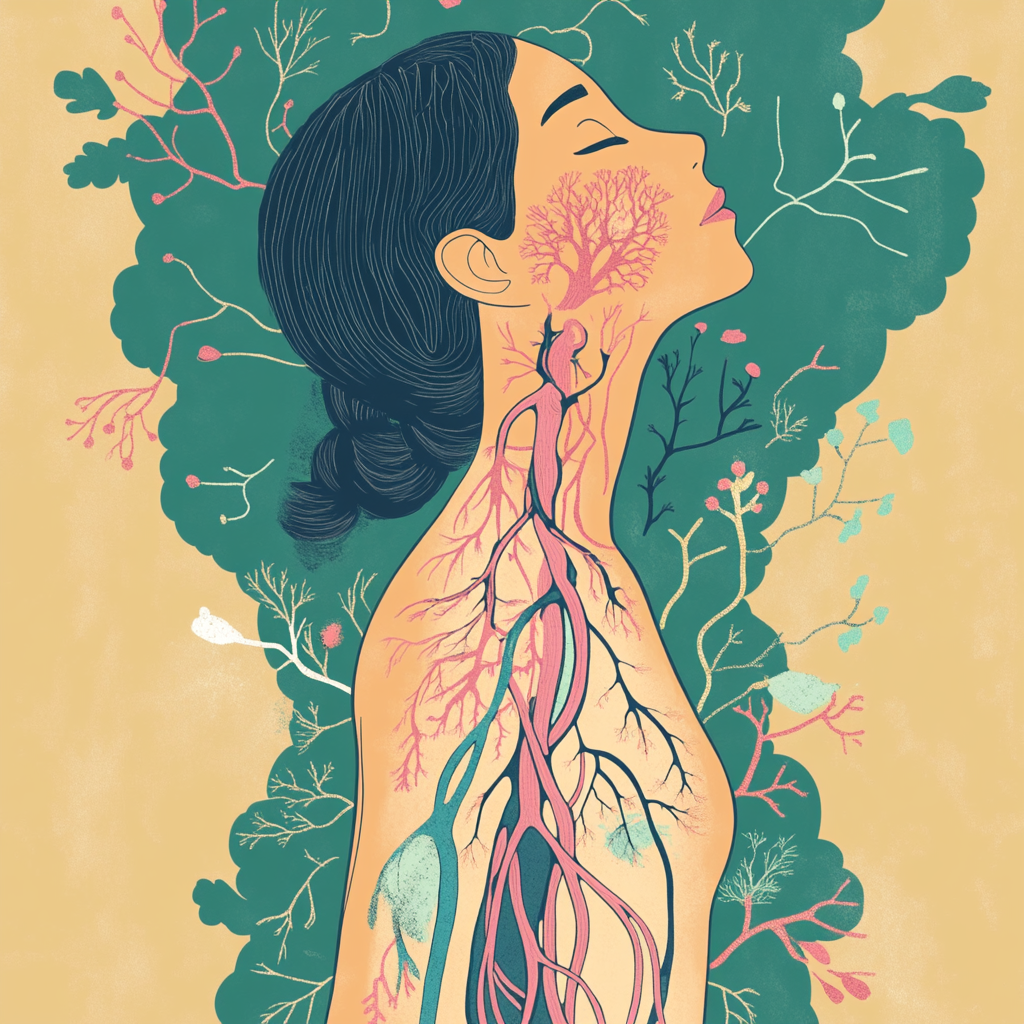
The other branch is the autonomic nervous system, and this is where nervous system dysregulation lives.
The Autonomic Nervous System
Your autonomic nervous system runs the things you don’t have to think about.
Heart rate. Breathing. Blood pressure. Digestion. Temperature. Muscle tone. Immune responses.
All the behind-the-scenes processes that keep you alive and functioning while you get on with your day.
Its main job is to constantly adjust your body based on what it thinks is happening around you.
In very simple terms, it’s asking one question over and over again:
Do I need to protect you right now, or are we okay?
To do this, the autonomic nervous system has two main modes.
The sympathetic nervous system is your protection system. This is the one that ramps things up when danger is detected.
The parasympathetic nervous system is your rest and repair system. This is the one that allows digestion, sleep, healing, learning, and connection to happen.
When the nervous system senses danger, the sympathetic system takes the lead and the body shifts into survival mode.
This is where you might have heard the terms fight, flight, or freeze.
Fight might look like:
- Irritability
- Anger
- Defensiveness
- Feeling ready to snap
Flight might show up as:
- Anxiety
- Restlessness
- Overthinking
- The urge to stay busy and “on the go.”
Freeze can feel like:
- Shutdown
- Numbness
- Brain fog
- Exhaustion
- Feeling stuck and unmotivated.
These responses might feel like an inconvenience, but they are automatic, protective reactions designed to keep you safe.
Imagine stepping off the curb and a car suddenly swerves toward you. Your heart races. Your muscles tense. Your breathing changes. You jump back without thinking. That’s your autonomic nervous system doing its job.
Once the danger passes, the parasympathetic system is supposed to bring the body back down again. This is regulation in action.
But sometimes it doesn’t – and that’s when the body gets locked into fight, flight or freeze.
Where Things Go Wrong
The problem is not stress itself.
Stress is normal. Helpful, even. In a healthy nervous system, stress rises when something demands your attention, then falls again once the situation passes. You deal with the thing, and your body settles.
In a dysregulated nervous system, that settling doesn’t happen properly.
The body keeps responding as if the threat is still there, even when it isn’t. Or it overreacts to things that aren’t actually dangerous. Or it struggles to shift back into rest once it’s been activated.
Over time, this creates a system that is always on edge, or completely exhausted – and that’s when symptoms start showing up.
So What Is Nervous System Dysregulation?
Nervous system dysregulation happens when the stress response stays switched on long after it is needed.
This can show up in different ways. Some people feel constantly anxious, restless, or on edge. Others feel flat, disconnected, or exhausted. You may feel all of these things.
This is not something you consciously control. It usually develops after:
- Long-term stress
- Illness
- Trauma
- Burnout
- Chronic overwhelm
- Or a series of smaller stressors that never really resolved.
At a certain point, the nervous system stops resetting on its own. The body starts treating everyday life as if it is a potential threat.
This is exhausting. And being stuck in a near constant state of fight, flight or freeze explains why people can feel so unwell without a clear medical explanation.
Common Signs of Nervous System Dysregulation
Not everyone experiences dysregulation the same way, but here are some of the more common patterns:
- Feeling anxious, rushed, or tense most of the time
- Feeling tired but unable to truly rest
- Difficulty sleeping or waking up feeling wired
- Ongoing and unexplained digestive issues
- Strong reactions to noise, crowds, or social situations
- Brain fog or difficulty focusing
- Ongoing muscle tension or pain
- Feeling emotionally reactive or emotionally numb
- Having unresolved medically unexplained symptoms
- ….and much much more
Ticking a lot of boxes here? You may want to explore this article “Do I Have a Dysregulated Nervous System?”
What Does a Well-Regulated Nervous System Look Like?
A regulated nervous system does not mean you float through life feeling calm and unbothered at all times. Regulation means flexibility, resilience, and capacity.
Flexibility
Flexibility means your nervous system can move through various emotional states appropriately – the highs, the lows, the stressful moments and the good ones. You get activated when it makes sense, and you can settle again without getting stuck.
Resilience
Resilience means your system can handle stress without falling apart. You might feel shaken by a tough day, a conflict, or a setback, but you’re able to recover instead of staying in survival mode for days or weeks afterward.
Capacity
Capacity means your system can hold a reasonable amount before it tips into overwhelm. Your “window” for stress is wide enough that everyday demands don’t completely wipe you out or send you into shutdown.
Signs of a regulated nervous system
People with more regulated nervous systems tend to notice some significant differences in how they move through life.
They still get stressed. They still have hard days, bad news, arguments, illnesses, and moments where everything feels like way too much. Regulation does not mean life stops happening.
The difference is how quickly their system recovers once the stress passes.
Instead of staying stuck in stress for days or weeks, their body can settle again.
This often looks like:
- Faster recovery from stress
They might feel rattled after a tough conversation or a busy day, but they don’t stay keyed up all night replaying it. Their body is able to downshift once the moment has passed.
- More consistent sleep
Sleep is not perfect every night, but it is generally more predictable. Falling asleep is easier. Night waking is less intense. Their body understands when it is time to rest.
- Better digestion
Appetite is more stable. Digestion is more reliable. They are less likely to swing between bloating, constipation, diarrhoea, or nausea during stressful periods.
- Emotional steadiness
Emotions still come and go, but they feel manageable. There is less emotional whiplash. Fewer sudden spikes of anxiety, panic, rage, or shutdown that seem to come out of nowhere.
- Less relational distress
They can tolerate closeness without feeling overwhelmed and handle conflict without spiralling. Misunderstandings do not feel like emergencies. They are less likely to people-please, shut down, or lash out under pressure.
- Greater capacity for life
They can hold more without collapsing. A busy week does not automatically tip them into burnout. Small problems stay small instead of stacking into overwhelm.
- Better recovery from illness and setbacks
When they get sick or run down, their body tends to bounce back more easily. Stress does not derail healing in the same way, because the nervous system is not constantly pulling resources into survival mode.
- Clearer thinking and decision-making
Their brain works better under pressure. They can think things through without panic taking over. Decisions feel less paralysing.
- A wider window of tolerance
Loud environments, change, uncertainty, and emotional conversations are easier to handle. Not always comfortable, but tolerable.
In short, regulation isn’t about being calm all the time. It’s about being able to respond, recover, and keep going without your nervous system constantly sounding the alarm.
Why “Just Relaxing” Doesn’t work for Nervous System Dysregulation
If relaxing were a choice, most people reading this would have chosen it already.
When the nervous system is dysregulated, telling someone to relax is like telling someone with a broken ankle to walk it off. The system is not refusing to calm down out of stubbornness. It genuinely does not feel safe enough to do so.
This is why well-meaning advice can feel frustrating or even insulting. Breathing exercises, yoga, meditation, and rest might be helpful for some people, but for those with deeper dysregulation they either do nothing, or make things worse.
The nervous system needs to really experience safety, not just be told about it.

Why Regulation Matters for Healing
The body does not repair itself efficiently when it thinks danger is ongoing.
When the nervous system is stuck in a prolonged stress state, the body has to prioritise protection over repair. Energy gets diverted away from things like digestion, immune regulation, hormone balance, inflammation control, and tissue repair.[*]
Those systems do not stop working completely, but they do not work well either.
Over time, this can contribute to symptoms that just don’t relent. Ongoing pain. Digestive issues. Sleep problems. Fatigue. Hormonal symptoms. Immune flares.[*] The body just never quite gets back to baseline.
The Chronic Stress and Chronic Illness Cycle
There is a strong correlation between chronic stress states and long-standing, relapsing, or medically unexplained symptoms. Not because stress is “all in your head,” and not because it caused everything, but because a body that does not feel safe struggles to heal.
In a sympathetic, high-alert state, the body is not designed to focus on recovery. It is designed to get you through the threat.
This is where people often get stuck in a frustrating loop:
- Chronic stress, illness, or trauma dysregulates the nervous system.
- A dysregulated nervous system keeps the body in protection mode.
- Protection mode interferes with healing.
- Symptoms persist or worsen.
- Those symptoms create more stress, fear, and uncertainty – and the loop tightens.
None of this means you imagined your symptoms.
None of it means you caused them.
And none of it means you should stop addressing the physical pieces.
What is does mean is that without nervous system regulation, the body may never feel safe enough to fully stand down and repair.[*]
Feeling Safe Enough to heal
Regulation does not cure everything. But it creates the conditions where healing becomes possible.
It gives the body permission to redirect energy away from constant vigilance and back toward rest, repair, and recovery. That is why nervous system work is not a replacement for medical care, therapy, or lifestyle changes, but a foundation that allows all of those things to work better.
When the system feels safer, the body can finally stop fighting imaginary fires and start doing what it is actually built to do.
How People Recover from Nervous System Dysregulation
There is no single approach that works for everyone. Nervous systems are shaped by different experiences, sensitivities, and stress histories.
Some people benefit from therapy. Others from body-based approaches. Some find structure and routine helpful. Others need very gentle, gradual input.
One important point is that more is not always better. If a nervous system is already overwhelmed, adding too many techniques can backfire.
This is where targeted, paced support can make a difference.
What Is the Safe and Sound Protocol?
The auditory system plays a major role in how we detect safety, respond to stress, and connect with others. SSP uses specially filtered music to work through this system, helping the nervous system reset and relearn what “safe” feels like.[*]
This is not binaural beats or just some relaxing tunes. SSP works at a biological level, engaging the nervous system in a targeted way – not just simply by trying to calm it down.
How Does SSP Actually Work?
At its core, SSP works through listening to music, but not in the way most people think.
The music is filtered to highlight specific sound frequencies that the nervous system associates with safety. These are similar to the tones of a calm human voice, a gentle breeze, or a mother singing a lullaby to her baby.
There are tiny muscles in your middle ear that help you tune into sounds of safety and detect potential danger. When your nervous system is dysregulated, neutral or safe experiences can get misread as threats, which keeps your system on high alert.
SSP uses specially filtered music to give these middle ear muscles a workout. This helps them “retune” to the sounds of safety. As your ears detect these signals more accurately, your nervous system receives the message that it does not need to stay on constant guard.
This is why SSP works at a biological level. It is not about trying harder to relax – it is about retraining the system that automatically decides whether the world is safe. Over time, this can improve stress tolerance, emotional regulation, sleep, digestion, and social comfort.
You can take a deeper dive into the science here.
Who Might Benefit from SSP?
SSP is often helpful for people who feel stuck despite trying many other approaches. This includes people dealing with:
- Chronic stress
- Anxiety
- Burnout
- Trauma-related symptoms
- Sensory sensitivity
- Digestive issues linked to stress
- Long-term nervous system overload
- Long covid
- – and much more.
That said, SSP is not suitable for everyone, and it should always be approached carefully and with guidance. Check out this article for SSP contraindications
What SSP Is and Is Not
SSP is not a miracle cure. It does not fix everything overnight. And it is not meant to replace medical care or therapy.
What it can do is support the nervous system so other forms of healing become easier and more effective.
Many people use SSP as a foundational nervous system support, alongside therapy, bodywork, or other treatments.
Curious about SSP?
If nervous system dysregulation sounds familiar, you are not broken and you are not alone.
Your body has been trying to cope with something for a long time. With the right support, nervous systems can change, stress responses can improve, and your capacity can increase.
At SSP Wellness Center, we work with people who feel overwhelmed, sensitive, or stuck and need a careful, personalised approach to nervous system regulation using the Safe and Sound Protocol.
If you are curious whether SSP might be appropriate for you, a free consultation might be a good place to start. And if nothing else, we hope this page helps you feel a little less confused and a little less alone.